
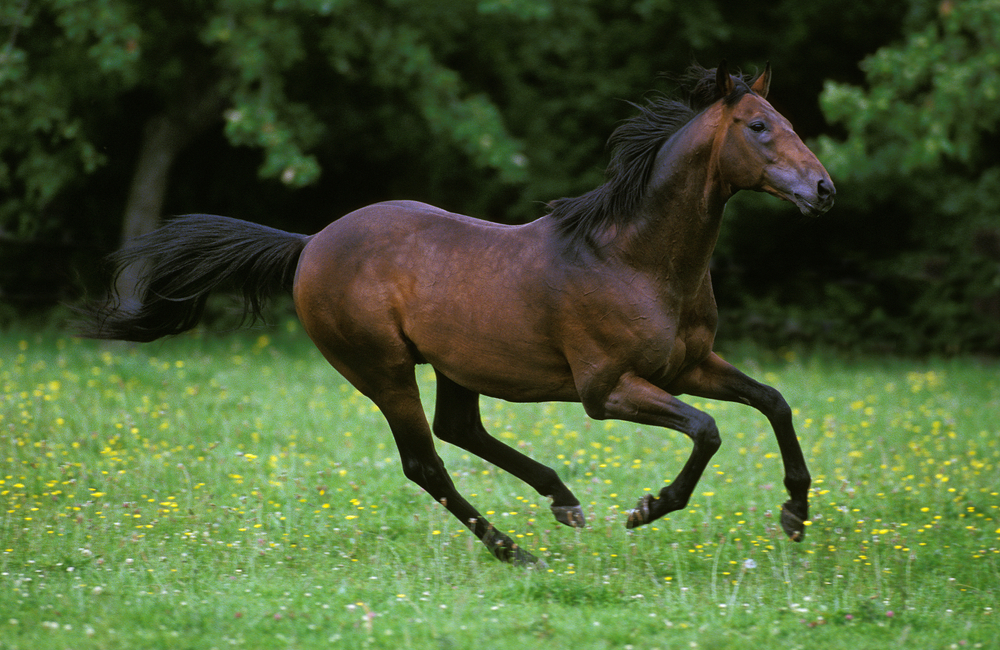
Short answer: it depends on the distance. An American Quarter Horse is built to accelerate rapidly and is usually the stronger sprinter over a quarter mile. A Thoroughbred is bred for speed plus stride length and stamina, so it is generally better suited to maintaining a high pace over longer race distances. “Which breed is faster?” is not a meaningful question without naming the distance, surface, race conditions, and individual horses.
Quarter Horse vs. Thoroughbred speed
Quarter Horse racing is centered on short races, commonly from 220 to 870 yards under American Quarter Horse racing rules. The traditional quarter-mile distance is 440 yards, or 402.3 meters. These races reward explosive acceleration, a powerful hind end, a fast start, and the ability to reach top speed quickly.
Thoroughbred flat racing covers a wider range of distances, from short sprints to routes of a mile or more. Thoroughbreds tend to have longer legs, a longer frame, and a stride suited to carrying speed over more ground. That does not mean every Thoroughbred beats every Quarter Horse. It means the breeds have been selected for different racing jobs.
Are Quarter Horses faster in a sprint?
Usually, yes. A Quarter Horse can launch from the starting gate with remarkable acceleration and may reach a higher peak speed during a very short effort. The race can be decided before endurance becomes the limiting factor. This is why Quarter Horse racing is associated with short, straight-line sprints rather than a long sustained run.
Peak-speed figures are easy to repeat and easy to misuse. A published “55 mph” figure is not a universal speed for the breed, and comparing it directly with a single Thoroughbred number can be misleading. Timing method, distance, wind, track surface, conditioning, and whether the number describes an instant peak or an average all change the result.
Are Thoroughbreds faster over longer distances?
Often, yes. Thoroughbreds are not simply “slower Quarter Horses.” They were developed for racing that demands speed over more distance, and their longer stride and aerobic capacity help them maintain a strong pace after the initial acceleration phase. In a route race, the horse that can conserve energy, settle into rhythm, and finish strongly may beat a horse that was quicker out of the gate.
Even within Thoroughbred racing, a sprinter and a distance horse can have very different strengths. The same is true of Quarter Horses: a racing Quarter Horse, a ranch-bred stock horse, and an individual bred for another discipline should not be treated as interchangeable examples of maximum speed.
How their builds affect performance
American Quarter Horse
- Compact, muscular build with powerful hindquarters.
- Exceptional acceleration and quick changes of direction.
- Commonly used in racing, ranch work, reining, cutting, barrel racing, and trail disciplines.
- Different types exist within the breed, including stock, halter, hunter, and racing lines.
Thoroughbred
- Taller, leaner frame with long limbs and a substantial stride.
- Selected for speed, athleticism, and the ability to sustain effort.
- Commonly associated with flat racing, but also successful in jumping, eventing, hunting, and other disciplines.
- Individual temperament and soundness matter as much as breed averages when choosing a riding horse.
Which horse would win?
Set the race first. In a short, straight sprint, a well-conditioned Quarter Horse is likely to have the advantage. Over a longer race, a fit Thoroughbred is more likely to maintain speed and finish effectively. On a turn, the surface, starting position, racing experience, and running style can change the outcome. A sound, well-trained individual can outperform a theoretical breed average.
It is also important not to confuse racing performance with suitability as a riding horse. A fast horse may be unsuitable for a novice rider, while a calmer horse may be the better partner for trail riding or jumping. Conformation, soundness, training, temperament, and the intended discipline should guide that decision.
What the distance changes
Race distance changes the physiological challenge. A short sprint is dominated by acceleration and anaerobic power; there is little time to recover from a poor break or an early burst. As distance increases, pacing, oxygen delivery, efficient movement, and recovery become more important. That is why a top sprint time cannot be used to predict the winner of a mile race.
Track conditions matter too. A fast, firm surface, a wet track, turns, headwind, and starting-gate design can all affect the clock. Comparing records from different venues without considering those variables creates a false sense of precision. Breed averages are useful for explaining selection and typical strengths, but they are not a promise about an individual horse.
Speed should not outrank welfare
Racing speed comes with a responsibility to protect the horse. Training should be appropriate to age, soundness, fitness, footing, and recovery. A horse that is repeatedly sore, struggling to breathe, losing weight, or showing a change in attitude needs veterinary assessment rather than a harder conditioning schedule. A faster breed is not automatically a healthier or better choice; responsible management matters more than a headline number.
Related horse guides
- 20 Most Popular Horse Breeds: traits, uses, and what makes them different
- 29 Horse Jumping Obstacles Explained for Beginners
- What Is a Bad Temperature for a Horse?
Sources
- American Quarter Horse Association (AQHA)
- International Federation of Horseracing Authorities: official Thoroughbred rankings and racing information

Written by
I've been around horses since I was 6 years old and started competing at the age of 9. Horses are my greatest passion and I am thrilled to be able to share my 23 (and counting) years of experience and knowledge with you.