
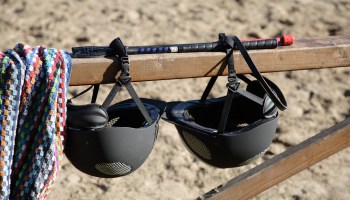
Short answer: Do not substitute a bicycle helmet for an equestrian helmet. A bike helmet is designed around cycling crash patterns; an equestrian helmet is tested and fitted for the risks of riding, including falls onto firm ground, contact with obstacles, and impacts involving the back or sides of the head. If you are riding, wear a properly fitted helmet certified to a current equestrian standard.
Why a bike helmet is not the right choice for riding
Helmet safety is not just about whether a shell feels hard. Standards define the impact conditions, coverage, retention system, and test procedures a helmet must meet. Cycling helmets are optimized for bicycle falls and are not a substitute for an equestrian helmet tested for horse-riding impacts. The two activities also produce different fall paths: a rider can be thrown over a horse, fall beside a horse, hit a jump or arena surface, or be struck by a hoof.
A bicycle helmet may also leave parts of the head less protected than an equestrian model, and its retention system may not be designed for the same combination of movement and impact. That does not mean every equestrian helmet prevents injury; no helmet can guarantee protection in every accident. It does mean the equipment should match the activity.
What helmet should you wear for horseback riding?
Choose a helmet specifically labeled for equestrian use and certified to a current standard accepted where you ride or compete. In the United States, look for an equestrian helmet carrying the ASTM F1163 standard and the SEI certification mark when required by your discipline or competition rules. Rules and accepted standards can change, so check the current rulebook for your governing organization rather than relying on an old article, a retailer listing, or a social-media recommendation.
For riders elsewhere, the accepted standard may differ. British and European riders may encounter standards such as PAS 015, VG1, or EN 1384, but the correct choice depends on the activity, country, and competition organization. Buy from a reputable equestrian retailer, confirm the certification label inside the helmet, and keep the receipt and model information.
How an equestrian helmet should fit
- Measure your head according to the manufacturer’s instructions, then try on the model rather than choosing by size alone.
- The helmet should sit level, low enough to protect the forehead, without rocking, pinching, or leaving a gap at the back.
- The harness should meet below the ears and lie flat. With the chin strap fastened, you should be able to open your mouth comfortably, but the helmet should not shift when you move your head.
- Have an experienced fitter check the fit if possible. Hair thickness, a ponytail, a liner system, and the shape of the shell can all change fit.
- Never add an unapproved hat, thick winter cap, or aftermarket padding that changes the fit or certification.
When should you replace a riding helmet?
Replace a helmet after a significant impact, even if there is no visible crack. Internal damage can be difficult to see, and a helmet that has absorbed an impact may not protect as intended next time. Replace it if the shell, liner, harness, or adjustment system is damaged, or if it no longer fits securely.
Manufacturers also publish replacement guidance because materials age through use, heat, sweat, ultraviolet exposure, and storage conditions. Follow the specific manufacturer’s service-life recommendation. Do not buy a used helmet unless you can verify its age, history, storage, and impact record; a hidden previous fall is an unacceptable safety gamble.
Do you have to wear a helmet when riding?
Legal and competition requirements vary by location, age, discipline, and venue. A private trail ride may have different legal rules from an organized show, and a barn’s insurance policy may impose requirements beyond the law. Many organizations require helmets for juniors and for specific classes, while others require them for all riders. Check the current rules for your organization and venue.
Regardless of the minimum rule, wearing a certified helmet is sensible for every ride. Horses can trip, spook, slip, or react to an unexpected noise without warning. A calm, experienced rider is not immune to an unpredictable fall.
Helmet safety checklist before you mount
- Confirm the certification label is present and intended for equestrian use.
- Inspect the shell, liner, harness, buckle, and adjustment dial or system.
- Fasten the harness and perform a quick movement check: the helmet should stay level and stable.
- Remove the helmet from service after any impact or if its history is unknown.
- Replace it according to the manufacturer’s guidance, not only when it looks worn.
For related safety planning, see our guides to show-jumping hazards, horse-jumping obstacles, learning to ride safely, and helmet choices in Western riding.
Frequently asked questions
Can I wear a bike helmet on a horse?
It is not recommended. Use a certified equestrian helmet designed and labeled for horseback riding instead.
Are horse-riding helmets safer than bike helmets?
They are tested for different activities. The relevant question is whether the helmet is certified for equestrian use and fits correctly, not whether one general helmet is safer in every situation.
Can a riding helmet be used for cycling?
Not unless the helmet is also specifically certified for cycling. Use equipment approved for the activity you are doing.
Does a helmet prevent all head injuries?
No. Helmets can reduce risk but cannot prevent every injury. Ride within your ability, use appropriate supervision, and follow venue and competition safety rules.
Safety note: This guide is general information, not medical or legal advice. Check the current requirements of your governing organization, venue, and helmet manufacturer.
Further reading: current U.S. Equestrian Federation rules and ASTM equestrian helmet standard information.

Written by
I've been around horses since I was 6 years old and started competing at the age of 9. Horses are my greatest passion and I am thrilled to be able to share my 23 (and counting) years of experience and knowledge with you.
Your article helped me a lot, is there any more related content? Thanks!