
Show jumping is demanding because horse and rider must solve a course of fences at speed while staying balanced, accurate, and attentive. The risk is real, but it is not a reason to treat every problem as inevitable. Good coaching, appropriate progression, soundness checks, maintained equipment, and a safe riding environment reduce preventable risk.
This guide covers 16 common hazards in show jumping and practical ways to manage them. It is not a substitute for a qualified instructor, veterinarian, medical professional, or the rules of your governing body. If a rider falls, do not remount until injuries have been assessed and it is safe to do so.
16 show-jumping dangers and how to prevent them
1. A rider progressing too quickly
Height is only one part of difficulty. A small course with poor balance, rushed turns, or an inexperienced horse can be more hazardous than a larger, well-built course. Progress when the current level feels routine—not when one good attempt makes the next height seem tempting.
Reduce the risk: Work with a qualified coach, repeat fundamentals, and increase height or complexity one variable at a time. Your horse should be confident and physically prepared for the question.
2. A horse that is unsound, sore, or fatigued
Refusals, rushing, bucking, landing unevenly, or suddenly losing confidence can be signs of pain, tack problems, poor footing, or fatigue. Jumping through those signs can turn a manageable issue into a fall.
Reduce the risk: Check the horse before and after work, stop when movement changes, and involve your veterinarian, farrier, saddle fitter, or trainer when the pattern persists. Never use training pressure to conceal a soundness problem.
3. Refusing or stopping at a fence
A stop can eject a rider forward because the horse loses momentum while the rider continues toward the jump. It may be caused by confusion, fear, pain, an unclear approach, or a fence that is beyond the horse’s current confidence.
Reduce the risk: Re-establish rhythm over a smaller, inviting fence. Use a straight approach, look beyond the jump, and ask your coach to investigate repeated refusals rather than simply adding pressure.
4. Ducking out
When a horse runs around the side of a fence, the rider can be pulled off balance or collide with a standard. Repeated ducking also teaches the horse that avoidance works.
Reduce the risk: Check pain and tack first. Then rebuild confidence with correctly placed ground poles, guide rails when appropriate, and smaller fences. Keep the line organized without trapping the horse or making the correction punitive.
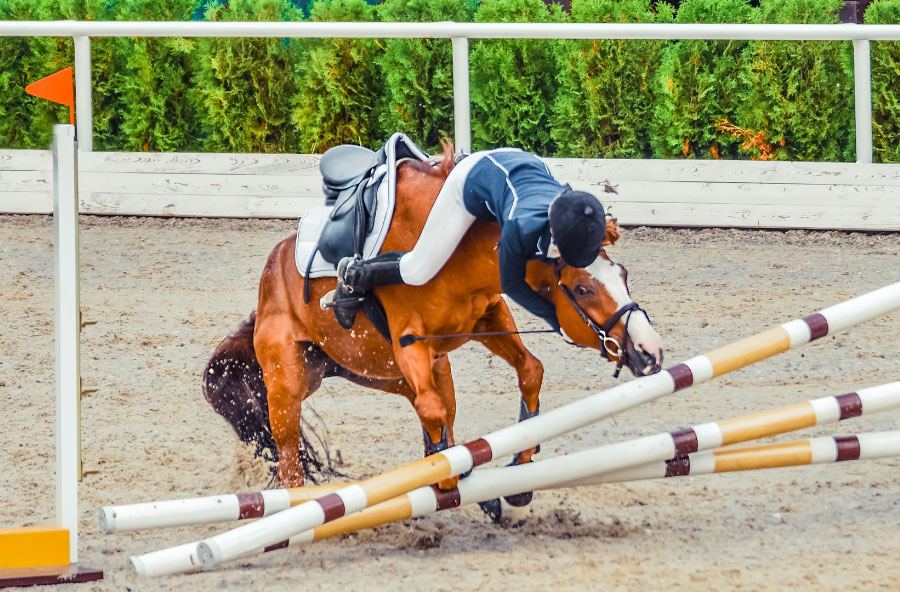
5. Tripping or falling on landing
A horse can catch a front toe, land awkwardly, or lose balance after a jump. The risk rises when the horse is tired, the footing is inconsistent, or the takeoff distance is poor.
Reduce the risk: Keep the horse fit, maintain appropriate hoof care, and use well-maintained arena footing. Inspect fences and use competition-compliant safety cups where required. Do not school when the surface is deep, slick, frozen, or uneven.
6. Slippery or unsuitable footing
Wet grass, compacted arena material, deep footing, and inconsistent patches can cause a slip at takeoff, landing, or a turn. A horse may lose traction even when the jump itself is simple.
Reduce the risk: Walk the surface before riding, adjust the exercise to conditions, and postpone jumping when traction is unreliable. Discuss studs or other traction choices with an experienced professional; incorrect use can create its own injuries.
7. A rotational or rotational-style fall
A horse that catches a solid obstacle or falls at a fence can rotate forward, placing both horse and rider at exceptional risk. Traditional arena show-jump fences are designed to fall, while eventing includes different obstacles and hazards—do not treat the disciplines as interchangeable.
Reduce the risk: School only obstacles appropriate to the discipline and your experience. Follow venue rules, use qualified supervision, and never improvise solid fences at home.
8. Falling in front of or behind the horse
A rider may be unseated over an awkward jump, a refusal, a sudden acceleration, or a landing. Falling in front of the horse creates a risk of being stepped on; falling behind can lead to a second fall when the horse changes pace.
Reduce the risk: Wear a properly fitted, current riding helmet and appropriate footwear. Practice position at low height, keep the lower leg stable, and use a neck strap or grab strap when your coach recommends one.
9. Foot caught in a stirrup
A rider who falls can be dragged if the foot remains lodged. This is why stirrup fit, footwear, and release systems matter.
Reduce the risk: Use boots with a defined heel and correctly sized stirrups. Inspect leathers, irons, and safety releases before every ride. Learn more in our guide to choosing stirrups.
10. Tack or equipment failure
Broken stitching, cracked leather, a damaged girth, loose bridle hardware, or a worn stirrup leather can fail at the worst moment. Second-hand equipment needs the same scrutiny as new equipment.
Reduce the risk: Clean and inspect tack regularly, especially billets, girth points, stitching, reins, and stirrup leathers. Replace components that are brittle, stretched, cracked, or damaged instead of hoping they last one more ride.
11. A loose or poorly fitted saddle
An unstable saddle can restrict the horse, slide on landing, or leave the rider unable to stay centered. Fit can change as a horse gains or loses condition.
Reduce the risk: Have the saddle checked by a qualified fitter and monitor pressure signs, behavior changes, and uneven sweat patterns. A saddle pad cannot correct a fundamentally poor fit.
12. Bucking, rearing, or sudden bolting
Defensive behavior may be caused by pain, fear, excess energy, confusion, or a learned response. Rearing is particularly dangerous because a horse can lose balance backward.
Reduce the risk: Do not jump a horse that is not mentally settled or physically comfortable. Seek experienced help, rule out pain, and keep the session simple. A rider should not try to solve a rearing problem alone.
13. Collision with a fence or another horse
Busy warm-up arenas and poorly planned schooling sessions increase the chance of a horse meeting a jump at the wrong angle or colliding with another combination.
Reduce the risk: Follow arena etiquette, announce your line, leave space, and avoid changing direction unpredictably. In a lesson, keep the number of jumping horses appropriate to the arena size.
14. Spooking at fillers, water, or distractions
Fillers, planks, flowers, shadows, banners, and a liverpool can look different from ordinary rails. The horse may hesitate, run out, or jump with an unexpected effort.
Reduce the risk: Introduce new visuals gradually at a low height and in a controlled setting. FEI’s 2026 Jumping Rules cover water jumps, water jumps with a vertical, and liverpools; competition requirements are not the same as home schooling, so check the applicable rules.
15. Inadequate protective equipment
A helmet cannot prevent every injury, but a properly fitted, standards-compliant helmet is essential. Depending on the discipline, venue, and rider, additional protection such as a body protector or air vest may be appropriate.
Reduce the risk: Replace a helmet after a significant impact, even if the shell looks fine. Review the current rules and fit guidance for your competition organization. Our article on body protectors in show jumping explains the decision points.
16. Poor preparation after a fall
The danger does not end when the horse stops. Adrenaline can hide concussion, fractures, soft-tissue injuries, or shock. A rider who remounts immediately may worsen an injury or fall again.
Reduce the risk: Have a ground person secure the horse, assess the rider, and follow the event’s medical protocol. Do not move a seriously injured person unless there is an immediate danger. Seek urgent care for loss of consciousness, confusion, neck or back pain, severe headache, vomiting, breathing trouble, or worsening symptoms.
Safety checklist before jumping
- Helmet is correctly fitted, fastened, and within the manufacturer’s replacement guidance.
- Boots, stirrups, stirrup leathers, girth, bridle, and reins are sound.
- Horse is moving freely and shows no sign of pain, lameness, or unusual fatigue.
- Footing, fences, lighting, and arena traffic are suitable for the exercise.
- Jump height, width, fillers, and course complexity match the horse and rider.
- A coach or responsible ground person knows the plan and can respond if something goes wrong.
Final takeaway
Show jumping cannot be made risk-free, but it can be made more deliberate. The safest riders are not the ones who never make mistakes; they are the ones who recognize when the horse, footing, equipment, or their own confidence is telling them to simplify the question. Build skills at a height where both partners can succeed, and treat repeated behavioral changes as information—not disobedience.
Related show-jumping guides
- 29 horse jumping obstacles explained for beginners
- How to help a horse that will not lunge
- How to choose the right stirrups
- Do show jumpers wear body protectors?
Sources and rule reference: FEI Jumping Rules, 28th edition, effective January 1, 2026; US Equestrian helmet ratings and Virginia Tech Helmet Lab information.

Written by
I've been around horses since I was 6 years old and started competing at the age of 9. Horses are my greatest passion and I am thrilled to be able to share my 23 (and counting) years of experience and knowledge with you.