- Your source for stall mats, rubber arena footing, arena harrows and arena dust control.
Introduction
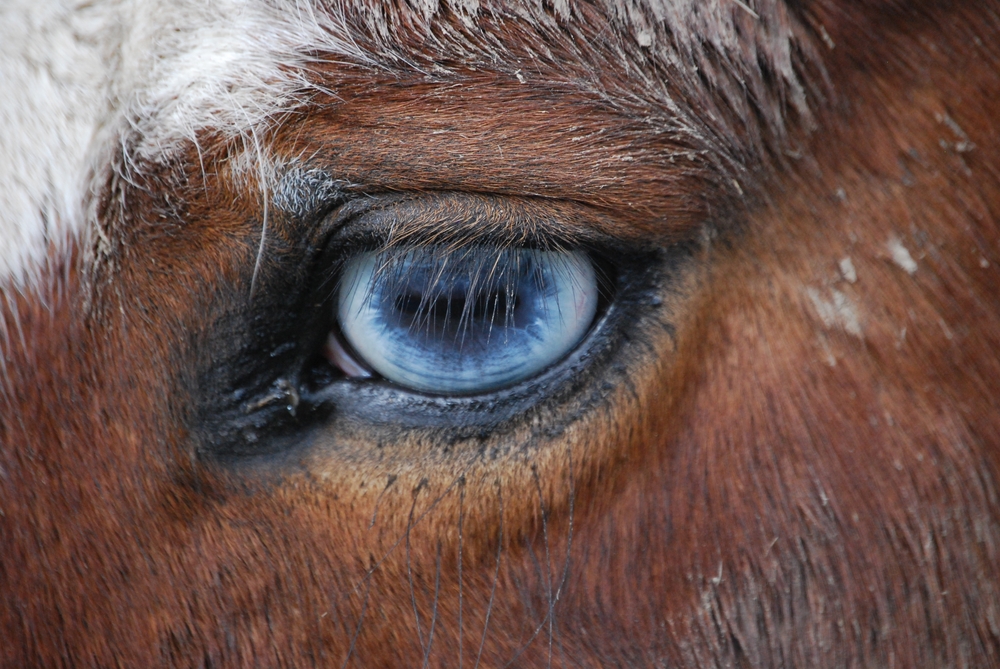
Understanding how horses see the world is essential for building trust, improving training, and ensuring the safety of both horse and rider. A horse’s vision is uniquely adapted for survival, shaped by their evolution as prey animals. By learning how equine eyes work, owners and handlers can communicate more effectively, anticipate reactions, and create environments that support equine comfort and confidence.
What Is Unique About Horse Vision?
Horses possess several key visual characteristics that differ from humans:
Monocular and Binocular Vision: Horses primarily use monocular vision—seeing different images out of each eye—to scan large areas. However, they also use binocular vision (both eyes focused forward) for depth perception in front of them.
Wide Field of View: Thanks to their eye placement on the sides of their heads, horses can see nearly 350 degrees around them, with only two small blind spots: directly in front of the forehead and directly behind the tail.
Motion Sensitivity: Horses are highly sensitive to movement, especially in their peripheral vision. This helps them detect potential predators but can also cause them to spook easily at sudden or unfamiliar changes.
Color Vision: While horses are not completely colorblind, they see a limited spectrum. They can distinguish some blues and greens, but reds and related hues appear more as shades of gray or brown.
How Horse Vision Affects Behavior
Blind Spots and Safety
Horses have blind spots directly in front of their nose and behind their hindquarters. Approaching a horse from these areas can startle them. Understanding this helps handlers approach horses from the side where they can be clearly seen.Depth Perception Challenges
Since horses switch between monocular and binocular vision, judging depth—like stepping into a trailer or over a jump—can be difficult. They often lower or tilt their heads to get a better look. Allowing time for them to assess unfamiliar objects reduces anxiety and resistance.Spooking at Movement
Because horses are prey animals with keen motion detection, sudden movements (even subtle ones like a fluttering plastic bag) can trigger a flight response. Calm, consistent handling and desensitization can help reduce startle reactions.Lighting Sensitivity
Horses take longer than humans to adjust between light and dark. Entering a dim barn or shadowed trailer may be intimidating. Gradual transitions and proper lighting can ease this discomfort.
How Vision Varies by Individual
Just like humans, horses can have differences in visual acuity. Age, injury, or disease can impair vision. Common issues include:
Cataracts: Clouding of the lens, common in older horses
Uveitis: Inflammation that can lead to blindness
Night Blindness: A genetic condition found in some breeds, like Appaloosas
Regular veterinary eye exams help detect and manage vision-related issues early.
Helping Horses See—and Feel—Better
Designing Safe Spaces
Use consistent lighting and avoid placing startling objects near stalls or riding areas. Bright contrasts, such as shadows or puddles, may look like holes or obstacles to horses.Training with Vision in Mind
Use clear body language and vocal cues. Give horses time to process visual information. Approach from an angle where they can see you well.Respecting the Horse’s Perspective
Remember that what looks harmless to a human may appear threatening to a horse. Training and trust-building go hand-in-hand with understanding how they view the world.
Limitations and Misconceptions
Myth: Horses see in black and white — False. While their color range is limited, they do perceive certain colors, especially blues and yellows.
Myth: Horses have perfect night vision — Not quite. They see better in low light than humans, but not in complete darkness.
Myth: Horses can’t see detail — Horses can detect motion and shape well but don’t see fine details like humans do.
Conclusion
A horse’s vision is finely tuned for survival—wide-ranging, motion-sensitive, and adapted to life as a prey animal. By understanding how horses see the world, owners and handlers can work with their instincts rather than against them. Whether it’s approaching thoughtfully, designing safer environments, or building trust during training, seeing the world through equine eyes leads to more harmonious and effective partnerships.