
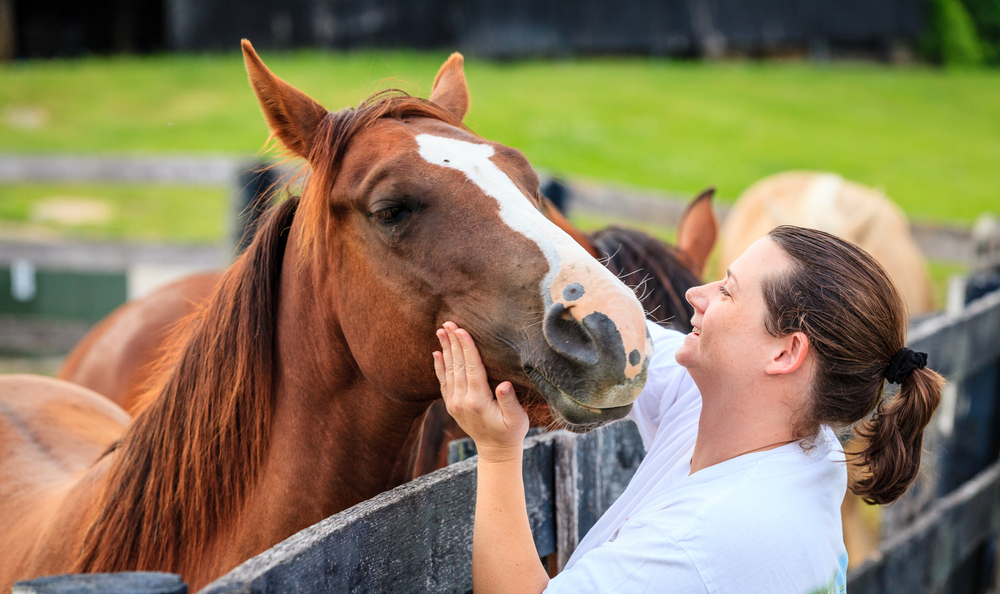
Do horses like humans? Some horses clearly seek human company, approach willingly, relax during familiar handling, or show enjoyment during grooming and other positive routines. But “like” is not a scientific switch that is either on or off. Horses are individuals, and their responses depend on learning, past experience, pain, temperament, handling, and the situation.
The most useful question is not whether a horse loves people in the human sense. It is whether the horse feels safe, understands what is being asked, and has learned that interacting with a particular person predicts comfort, food, turnout, grooming, or other good outcomes.
Do horses form bonds with people?
Horses can recognize familiar people and learn to distinguish between different handlers. They also learn from human body language, voice, timing, and consistency. A horse may walk toward a trusted person, lower its head for a halter, stand quietly for grooming, or remain soft and attentive during routine care. These are useful signs of trust and cooperation, although they should be interpreted alongside the horse’s ears, eyes, posture, breathing, and willingness to move away.
That relationship is not identical to a human friendship. Horses are social prey animals whose strongest natural social relationships are usually with other horses. A friendly response to a person may reflect trust, positive reinforcement, predictability, social comfort, or a practical association with care. It can still be a meaningful relationship without requiring us to assign human emotions to every behavior.
Signs a horse is comfortable with you
- It approaches or stays near you without being trapped or pressured.
- Its neck and facial muscles look soft rather than rigid, and its breathing remains calm.
- It accepts routine handling, grooming, or fitting equipment without repeated avoidance.
- It investigates you with a relaxed posture and can return attention to you after a distraction.
- It can communicate “not now” by stepping away, and you respect that signal.
No single sign proves affection. A horse may stand still because it has been trained to do so, while a horse that steps away may simply need space, be uncomfortable, or be unsure what comes next.
How horses learn to trust people
Trust grows from repeated, predictable interactions. Use clear cues, release pressure promptly when the horse responds, avoid surprising movements, and keep sessions short enough that the horse can remain relaxed. Reward calm behavior with a pause, a scratch in a preferred spot, turnout, forage, or another reward that is safe and appropriate for that horse.
Good horsemanship also includes choice. Do not force a horse to tolerate prolonged hugging, face-to-face contact, or rough play because it looks affectionate in a photograph. Stand where you can move safely, avoid crowding the horse, and watch for early stress signals such as a fixed stare, tight mouth, raised head, swishing tail, pinned ears, repeated foot movement, or sudden stillness.
Why a horse may seem distant
A horse that avoids people is not necessarily “mean” or incapable of attachment. It may have had frightening handling, may not understand the person’s cues, or may be protecting itself. Pain is another important possibility. Changes in behavior around grooming, saddling, leading, loading, or mounting deserve a careful check of tack, feet, teeth, musculoskeletal comfort, and general health with qualified professionals.
Food can also complicate interpretation. A horse that follows a person for treats may be motivated by a learned reward rather than seeking social contact. That is not bad, but it is different from evidence that the horse wants physical interaction.
Can you make a horse like you?
You cannot demand affection, but you can become safer and more predictable. Learn the horse’s normal behavior, use consistent handling, provide appropriate turnout and horse-to-horse contact, and stop before frustration escalates. Build trust in small steps rather than testing the relationship with frightening challenges.
If a previously friendly horse becomes withdrawn, aggressive, unusually reactive, or reluctant to be touched, treat the change as information. Arrange a veterinary assessment when pain or illness is possible, and ask an experienced trainer or behavior professional to observe the interaction. Punishment may suppress a warning without fixing the reason behind it.
Sources and further reading
The research behind this guide supports a careful distinction between recognizing a familiar person, responding to learned cues, and claiming that a horse experiences human-style friendship. A peer-reviewed study found that horses can use multiple human characteristics when recognizing people across sensory cues, while another study examined how horses follow human-given cues and found that a longer caretaker relationship did not, by itself, guarantee better performance. These findings support observing the individual horse’s behavior in context rather than treating one friendly gesture as proof of affection.
- Horses cross-modally recognize women and men (peer-reviewed study, Scientific Reports via PubMed Central).
- What drives horse success at following human-given cues? (peer-reviewed study, Animals via PubMed Central).
Related horse-care guides
- Why does a horse rub its head on you?
- Are horses afraid of mice?
- Do horses sit?
- How do wild horses maintain their hooves?
Frequently asked questions
Do horses remember people?
Horses can learn to recognize familiar people and associate them with particular experiences. Their response may change when the person’s voice, clothing, movement, or the surrounding situation changes.
Do horses prefer humans or other horses?
Horses are social animals and generally need appropriate contact with other horses. A trusting human relationship is valuable, but it should not replace suitable equine companionship and normal welfare needs.
How do I know if my horse trusts me?
Look for consistent willingness to approach, calm body language, relaxed responses to routine handling, and the ability to move away and return without pressure. Interpret behavior in context rather than relying on one gesture.
Why does my horse pin its ears at me?
Pinned ears can signal discomfort, fear, frustration, guarding, or a warning. Give the horse space, check for pain and triggers, and seek qualified help if the behavior is repeated or escalating.

Written by
I've been around horses since I was 6 years old and started competing at the age of 9. Horses are my greatest passion and I am thrilled to be able to share my 23 (and counting) years of experience and knowledge with you.