
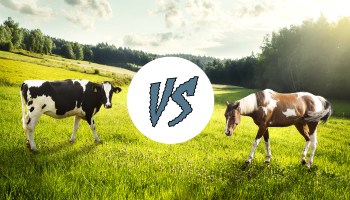
Short answer: “Smarter” is too broad to produce a fair winner. Horses and cattle can learn, remember, discriminate between people, and adapt to handling, but they have been selected for different jobs and live in different social and physical environments. This guide compares those abilities without treating a rough brain-size ratio or a made-up score as a scientific intelligence test.
Research on animal cognition is strongest when it measures a specific ability—such as memory, learning speed, problem-solving, or social recognition—in a controlled setting. Breed, age, training history, health, motivation, and the way a test is designed can all change the result. Use the comparison below as practical context, not a definitive ranking.
I guess the question “are horses smarter than cows” is very subjective. But I think we can take a look at this topic without intentionally offending any of the bovine or equine community! So are horses smarter than cows?
Older versions of this comparison treated brain size, temperament, and affinity for humans as if they could be combined into an intelligence score. That is not a valid scientific test. Horses may look more responsive in human-led work because they have different selection histories and training, while cattle show their own learning and social abilities in different settings.
So let’s have a look at the comparisons and the key metrics used to attempt to answer this question, hopefully without offending anyone!
Some Background
This ability to measure intelligence has been a headscratcher that scientists have only recently come up with ways to evaluate in humans, notably, the IQ scale. When it comes to evaluating the intelligence of animals, it is a completely different kettle of fish, so to speak!
Studies have proven that some species such as dolphins and whales have much higher intelligence than we first gave them credit for. They may even have an intelligence level that is close to our own!
Traditionally, horses have filled the role of a working animal in service of mankind, and cows more in the arena of food production. Oxen have historically been used to pull wagons and other heavy loads, but that has been about the extent of their use as working animals.
By the very nature of being a working animal, a horse has to have the ability to learn and take instruction from humans. But does that mean that cows don’t have the smarts to do the same?
Maybe the right approach is to examine the characteristics of each animal and compare them to each other to evaluate this question.
Let’s compare the evidence carefully across brain organization, learning, social recognition, and human handling—without inventing a single score for intelligence.
Relative Brain Size
Brain size and measures such as encephalization quotient can be used in comparative biology, but they are not stand-alone measures of intelligence. Body size, brain organization, sensory systems, motivation, development, and the task being tested all affect what an animal can learn and how it responds.
Brain-to-body ratios do not justify assigning horses or cattle a numerical intelligence score. A fair comparison has to measure a defined ability under comparable conditions.

Temperament
An animal’s temperament may not be an evaluation of their intelligence as such but does give us an indication of their ability to learn.
While some horses may display a high strung temperament, and others a nervous disposition, they seem to display the ability to learn to calm down once they have determined who or what is not a threat. The high strung temperament also seems to be rather a product of breeding rather than an inherent trait in the animal.
Cattle and horses show wide individual variation in reactivity and handling responses. A calm-looking animal is not necessarily less attentive, and a reactive animal is not necessarily more intelligent. Temperament reflects genetics, early experience, health, environment, and the way people interact with the animal.
Horses also seem to display the ability to learn to be comfortable in a situation, given time. In other words, adjust their temperament according to the situation once they have learned there is no danger. On the other hand, cows definitely show more singlemindedness and use their size to bust out of a situation they don’t like!
When comparing the temperament of cows and horses, the term “bull in a china shop” comes to mind. To say “horse in a china shop” does not quite carry the same connotation!
For this comparison, temperament is useful context—but it should not be converted into a species score or used to predict how an individual animal will learn.
Ability To Learn
The ability to learn was something that was alluded to in the previous section, but we will expand on it here. Horses seem to display a greater ability to evaluate situations, and change behavior accordingly and seem to be able to retain information longer. For example, if a horse learns where you keep his treats, good luck in keeping him from robbing you of treats day after day!
Cows, on the other hand, seem slower to learn this kind of behavior and seem to retain the memory for shorter periods.
Horses seem to actively seek out comfort and will return to the place where they find comfort time after time. The same cannot be said for cows, who do not seem to seek out comfort, other than the security of the herd.
The ability of horses to learn tasks from humans also appears to be vastly superior to the ability of cows. This is not to say that cows can’t be trained, but horses are definitely the quicker study in this area!
Both species can learn routines and associations; apparent speed depends heavily on the task, reinforcement, handling, and prior experience.

Affinity To Humans
Animals have an innate fear of humans that is part of their natural instinct. This is because humans are at the top of the heap in the animal kingdom! It is even, in certain circumstances for humans to stare down a lion charge, although I would not recommend this as a regular pastime!
Domestic animals show varying levels of affinity to humans, the species that they should instinctively be terrified of! The level of affinity to man shows the animal’s ability to evaluate, and learn and change their behavior!
Horses have demonstrated this ability to a greater degree than their bovine counterparts! Horses have been known to actively seek out the companionship of people and can develop lifelong bonds with their owners. Horses have even shown the ability to not like some people, yet be completely comfortable around others. Does this show ability for horses to be able to instinctively judge human character?
Cows are generally not tolerant of humans and often show the instinctive fear displayed by other animals. Although there have been recorded cases where cows have befriended people and become attached to them, this behavior is more the exception than the rule!
Human affinity also varies by individual and management history, so it is not a reliable species-wide intelligence score.
What the evidence can—and cannot—show
There is no scientifically defensible scoreboard that proves one species is smarter overall. Horses may outperform cattle on a task designed around rapid responses to riding or handling cues, while cattle may excel at other learning, memory, navigation, or social tasks. Results depend on the individual animal and the test.
Use comparisons as a starting point, not a reason to label either species as dull or difficult. Good welfare, clear training, appropriate motivation, and veterinary attention when behavior changes matter more than a species ranking.
Conclusion
The fair answer is that horses are not proven to be universally smarter than cows. They often appear especially responsive in human-directed work because of their history, training, and the tasks people commonly ask them to perform. Cattle can also learn, remember, recognize individuals, and solve problems.
The useful conclusion is to compare specific abilities under fair conditions—not to rank an entire species from a handful of informal observations.
What the comparison really tells us
Horses often appear exceptionally responsive because they have a long history of selection for movement, cooperation, and rapid responses to human direction. Cattle can also learn routines, recognize individuals, solve feeding problems, and form strong social preferences. A quieter or less visibly reactive animal is not necessarily less intelligent.
For owners, the useful question is not which species wins. It is whether the individual animal can learn the task, whether the training is clear and low-stress, and whether pain, fear, poor vision, hunger, or an unsuitable environment is interfering with behavior.
Related horse-behavior guides
Sources and further reading
Comparative cognition research does not support a universal intelligence ranking between horses and cattle. A peer-reviewed review of farm-animal cognition discusses learning, memory, social recognition, communication with humans, and social learning across ungulate species, including both horses and cattle. Those findings support comparing specific abilities and individual behavior rather than declaring one species smarter overall.
- Frontiers in Veterinary Science: Farm Animal Cognition—Linking Behavior, Welfare and Ethics
- PubMed Central: Farm Animal Cognition—Linking Behavior, Welfare and Ethics
Frequently asked questions
Are horses smarter than cows?
There is no single scientifically valid yes-or-no answer. Horses and cows show different strengths depending on the task, their history, and the conditions of the test.
Can cows learn and recognize people?
Yes. Cattle can learn routines, distinguish familiar individuals, and respond differently to handling and surroundings. Their intelligence should not be judged by how much they resemble horses in behavior.
Does a larger brain mean a smarter animal?
Brain size alone does not measure intelligence. Body size, brain organization, sensory ability, motivation, and the specific skill being tested all matter.
How can I tell whether my horse is learning?
Look for consistent responses to a clear cue across calm sessions, while ruling out pain, fear, vision problems, and confusion. A veterinarian or qualified trainer can help when behavior changes suddenly.

Written by
I've been around horses since I was 6 years old and started competing at the age of 9. Horses are my greatest passion and I am thrilled to be able to share my 23 (and counting) years of experience and knowledge with you.